
≤0.05%
Chipping rateA-grade cells · lowest on this range
Laser Scriber
SML-C72 High-Speed Laser Scriber — Built to Cut Cells Without Damage
It opens the module line by separating each full cell into halves — not by snapping it over an edge, but by scoring a shallow groove with the laser and parting the cell along that line with heat.
One number decides whether that was the right way to cut. It sits on the left.
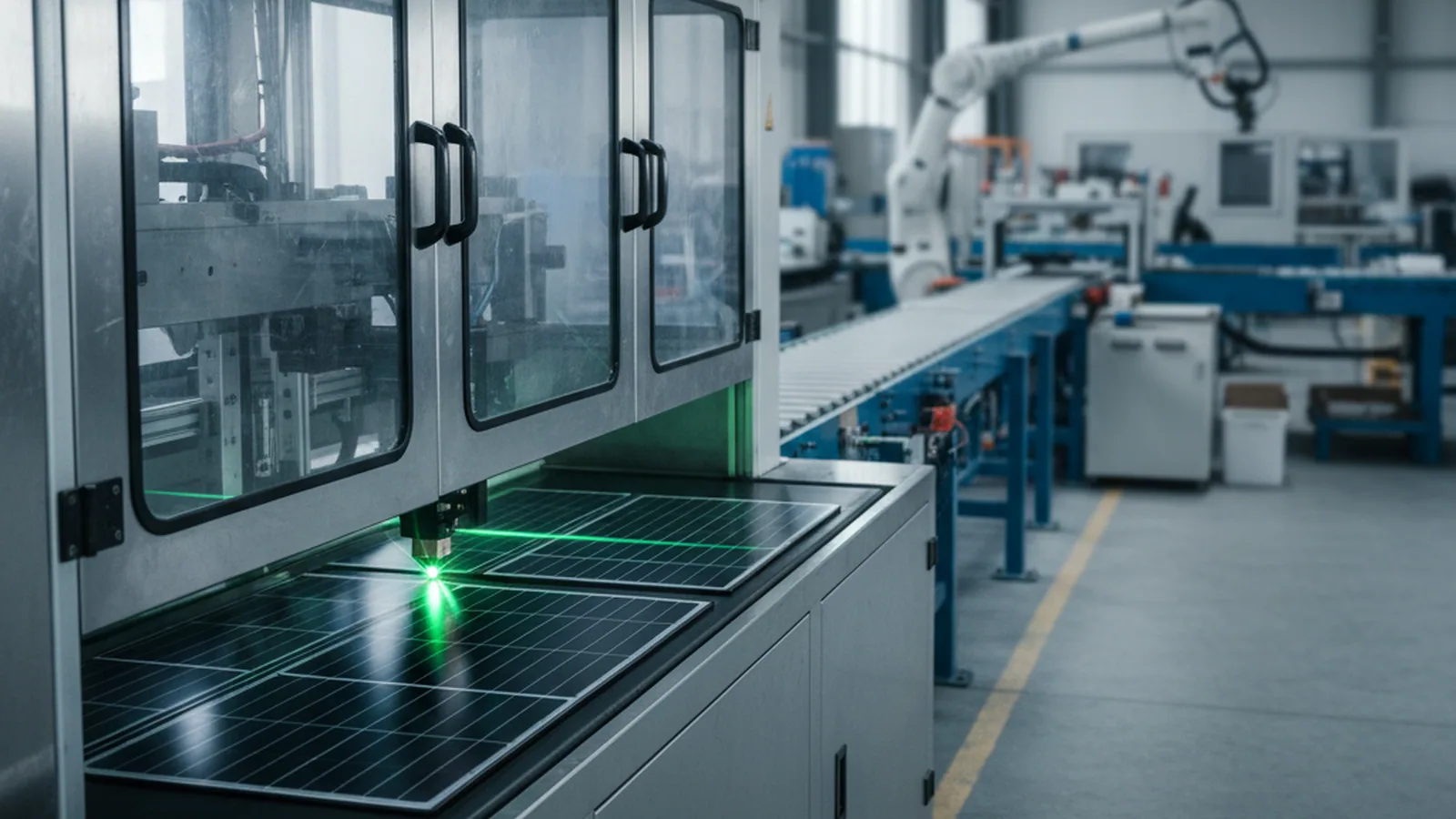
Whole cells in → lossless half cells out
Where it sits
Where This Machine Sits
Place the machine before you read a parameter. The SML-C72 owns the first station on the module line — scribing — where full cells become the half cells everything downstream is built around.
The scriber sits on a boundary and touches two interfaces only.
| In-feed | it takes whole cells, 166–210 mm, from your cell supply. |
|---|---|
| Out-feed | it hands the stringer cells already separated by laser. |
Confirm the split ratio early
The standard tooling cuts each cell into two. A different split ratio is a tooling question, not a machine one — worth settling before the order rather than at commissioning. Because every cell leaves cut the same way, the station after it never has to correct for a cut that wandered.
Who it's for
Who This Machine Is For
A high-speed scriber is not the only scriber. This split isn't a ranking — it's which throughput class and route each machine was built to hold, so you read the right spec sheet the first time.
Built for this machine
- BC cells first, TOPCon and PERC too — 166×166 to 210×210 mm, on any of the three routes.
- High-throughput lines — BC full cells at ≥4800 pcs/h; TOPCon and PERC at ≥6800 pcs/h on the double-line.
- Cells 120–220 μm — standard two-way split, cut lossless rather than snapped.
- Lines that carry a water utility — the cut is water-cooled, so the machine belongs where that supply is planned.

Not this machine — where to go
- Lower throughput or a smaller footprint — the SML-C20 is the entry scriber, on a single-phase supply and the smallest footprint in the range.
The difference between the two scribers is throughput class and utilities, not quality of cut. To weigh both scribers side by side — cut method, throughput and where each fits — see the laser scribing machine page →
Full spec
Full Specification
This is the table your process team checks the cut against — the laser powers, the heat-affected-zone controls, positioning and the two inspection gates, read line by line. The physics behind each number is unpacked in the sections below; here it's the bare checklist.
Two throughput figures sit on the table on purpose: ≥4800 pcs/h is BC full cells, ≥6800 pcs/h is TOPCon and PERC on the double-line. Read the row that matches your route, not the higher number.
| Parameter | Value |
|---|---|
| Process | |
| Cutting method | laser grooving + thermal cleaving (lossless) |
| Applicable cell | BC (also TOPCon / PERC), 166×166–210×210 mm |
| Cell thickness | 120–220 μm |
| Split | two-way split standard |
| Throughput | |
| Capacity | BC full cell ≥4800 pcs/h; TOPCon / PERC ≥6800 pcs/h (double-line) |
| Utilization | ≥95% |
| Chipping rate | ≤0.05% (A-grade cells) |
| Cutting speed | ≤500 mm/s |
| Laser | |
| Grooving power | 60 W |
| Cleaving power | 300–500 W |
| Laser warranty | 20000 h |
| Precision | |
| Positioning accuracy | ≤±0.05 mm; angle ≤±0.04° |
| Cooling | |
| At the cut | water-spray cooling to limit the heat-affected zone |
| Cleave cooling | deionized or purified water; downstream heated belt dries the cells |
| Inspection | |
| In-feed | position, chipping, missing corner, cracks, 90° flip, dirt, scratches — with NG rejection |
| Out-feed | cracked, chipped-corner and off-size cells |
| Utilities | |
| Power | 380 V / 50 Hz / 40 A; single-side 15 kW |
| Dimensions / weight | 4000×2700×2700 mm / 5000 kg |

Laser head detail

Water-cooled cut zone
The lossless cut
Why the Cut Leaves No Microcracks
The question that matters is not how fast the cell is cut, but what force does the cutting — because a cut is the first place a hidden crack can be born.
Where a Mechanical Snap Plants Microcracks
Snapping a cell mechanically parts it by bending the silicon until it breaks. The break edge is where the stress concentrates, and that is exactly where microcracks start — a fracture that runs a little further than the break, into the cell you are keeping. You can't see it here. You find it downstream, as a hidden-crack reject the line already paid to build.
Two Stages: Score, Then Thermal Cleave
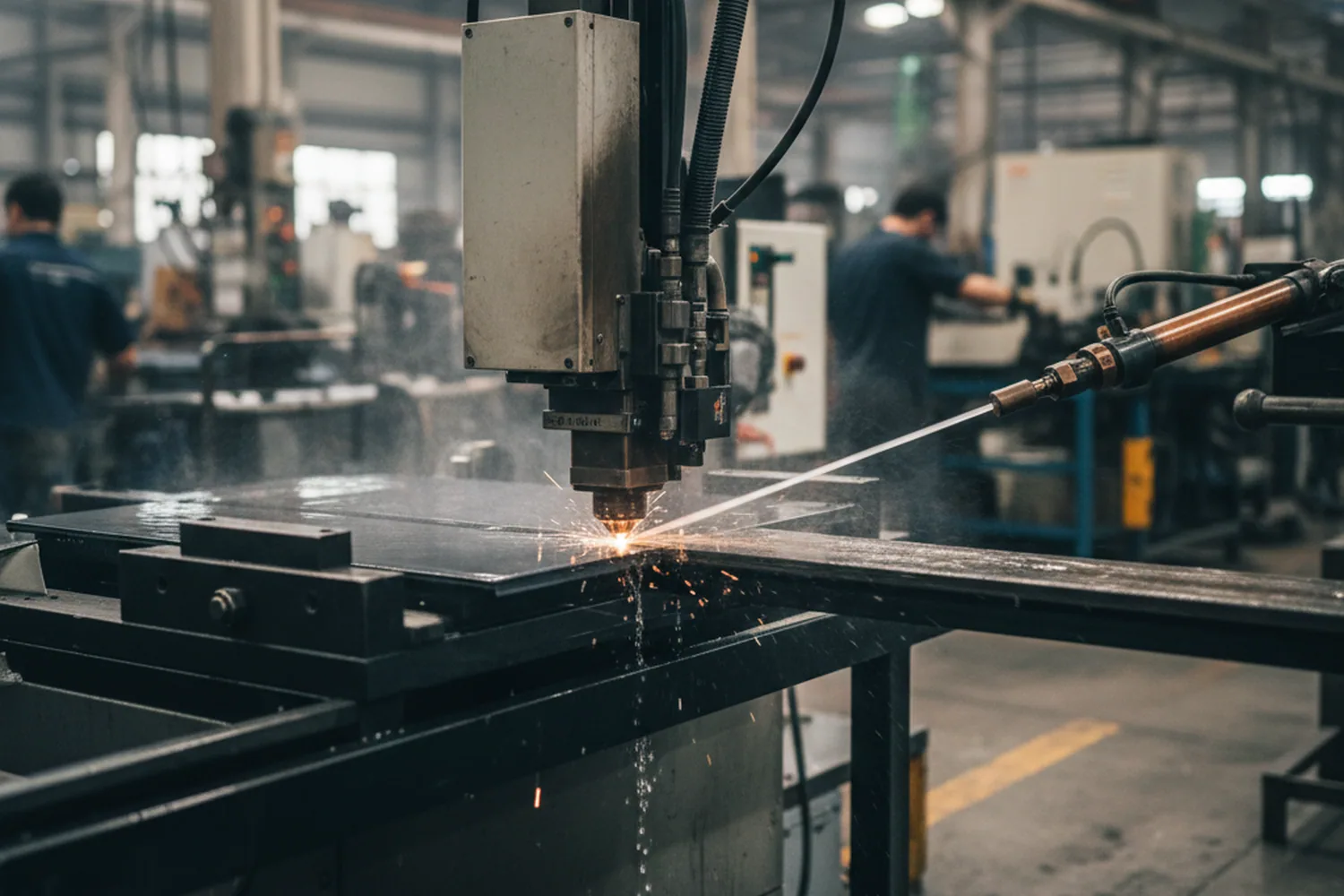
The SML-C72 never bends the cell. It parts it in two stages. First, a 60 W laser scores a shallow groove exactly along the line where the cell should separate — no material removed, just a scored path. Then a 300–500 W pass runs heat along that groove, and the cell parts along the score under thermal stress, following the line the groove already drew.
No Bending Force on the Silicon
Nothing pushes on the silicon; the cell separates where it was told to, not where a bending stress happened to find the weakest point. Water spray at the cut confines the heat-affected zone, and the pass runs at ≤500 mm/s — fast enough for throughput without dragging heat into the cell.

The evidence is one number you can check before you order: chipping holds at ≤0.05% on A-grade cells — and because there is no bending break, there is no microcrack edge to carry forward at all.
The cut, step by step
The Cut, Step by Step
The cut is four moves in order, and each one hands a stable condition to the next. Break the order and you break the result — which is why the machine runs them as one sequence, not four adjustable knobs.
Groove
The 60 W laser scores a shallow line where the cell will part, setting the exact path the separation will follow.
Thermal cleave
The 300–500 W pass runs heat along the groove, and the cell separates along the scored line under thermal stress — no mechanical force on the silicon.
Water-spray cooling
Water at the cut holds the heat-affected zone tight, so the silicon beside the groove is never overheated.
Transport and dry
A downstream heated belt dries the cells before they move on to stringing, so nothing wet leaves the station.
A cut made wrong here isn't free to fix later — it becomes a hidden-crack reject found at EL, after the line has already strung, laid up and bussed it. Running the four as a fixed sequence is what turns a clean cut from a hope into a repeatable condition.
Groove
Thermal cleave
Water spray
The numbers
The Three Numbers Behind the Cut
These are the numbers that say how clean the cut is, not how fast — the three the front of your line is signed against. Glance at them and you know whether the silicon leaves this station intact.
≤0.05%
Chipping rate, A-grade cells
20000 h
Laser source warranty
≥95%
Utilization
Utilization means 1 minus unplanned downtime over 24 hours — a floor you can hold, not a peak you see once. The laser warranty matters because the source is the part that decides the cut: a long-life source keeps that first, defect-setting pass consistent over years, not just at acceptance.
Precision & inspection
How the Cut Stays on the Line
Precision here isn't the machine looking accurate — it's the groove landing on the exact line the cell must part along, cell after cell. Positioning holds ≤±0.05 mm with angle ≤±0.04°, and that's what keeps the scored path where it belongs.
- 1
Positioning keeps the groove on line
A groove a fraction off line means a cut that parts off line, and an off-line cut is an off-size half the stringer downstream can't place. ≤±0.05 mm positioning with ≤±0.04° angle is what holds it.
- 2
The in-feed gate reads every whole cell
Before a cell is cut it's read for position, chipping, a missing corner, cracks, a 90° flip, dirt or a scratch, and the NG cells are pulled out — a cell already damaged on arrival should never take a laser pass.
- 3
The out-feed gate reads the result
After the cut, the halves are checked for a cracked cell, a chipped corner or an off-size piece, so nothing that cut wrong reaches the stringer.

The reason to catch it at both ends is cost. A bad cell rejected at in-feed costs one cell and a moment of the laser's time; the same cell missed here rides into stringing, gets soldered into a string, and takes the whole string down when it finally shows.
Cooling water
The Cooling Water Is a Utility to Plan
One boundary is worth settling before the machine lands, because it's easy to miss on a utilities plan: the cut is cooled with water — and not water off the mains.
What the machine needs
- Deionized or purified water for the cleave cooling — a prepared supply, not a tap.
- A downstream heated belt dries the cells, so the water never travels forward with them.
What that means for your plan
- Water becomes a fourth utility alongside power, air and exhaust — one most drop plans forget until the machine is on the floor.
- The supply, loop and quality are a site condition, not a machine setting, so they belong with your layout.
Where the water supply, its quality and the rest of the site conditions are laid out in full — power, air, exhaust, floor and environment — has a page of its own.
See the line utilities and layout page for how the water fits your buildingDownstream
What Sits Downstream
The scriber only earns its cut if the station after it takes the cells cleanly — so here's the one handoff that matters, without listing the whole line.
-
Stringing takes the half cells next
The separated cells feed straight into a stringer, which solders them into strings. The docking and interface detail lives on the stringer pages, not here.
-
Everything else is one click away
The full station-by-station line, and which machine runs each, is covered where it belongs rather than repeated on this page.
Your floor
Measure Your Floor First
This machine asks your building for something no other station does — water: scribing sprays water at the cut to shrink the heat-affected zone, and splitting cools with deionized or pure water, so the C72 needs both a feed and the right water quality, not just a drain.
| Item | SML-C72 |
|---|---|
| Footprint | 4000×2700×2700 mm |
| Weight | 5000 kg |
| Power | single-side 15 kW · 380 V / 50 Hz / 40 A |
Other scriber
The Other Scriber
If a high-speed lossless cut isn't your throughput class, the range has one other scriber — here's where it sits, so you land on the right one instead of forcing a fit.

SML-C20 — Entry Scriber
The entry-level scriber for lower throughput and a smaller footprint, on a single-phase supply. Where you go when the line doesn't need high-speed lossless cutting.
Compare
Both scribers, side by side
Cut method, throughput class and where each fits — the full comparison of the two laser scribers sits on one page.
See the laser scribing machine pageAfter you buy
After You Buy
The part that does the cutting is the laser, and it carries a guarantee of its own.
The laser source carries its own 20000 h warranty
On the SML-C72 the laser source is warranted for 20000 hours, separate from the machine around it — and because the source is what decides cut quality and running cost over the years, that figure belongs in the agreement by name rather than folded into the frame's cover. Accept the machine with the 20000-hour source warranty written in, and you know exactly what stands behind the one component that does the work.
See how acceptance is run
Get a proposal
Get Your Configuration Proposal
Send the cell drawing, get a proposal back — the low-effort next step, before any commitment.
A configuration proposal back within 24 hours · email.